


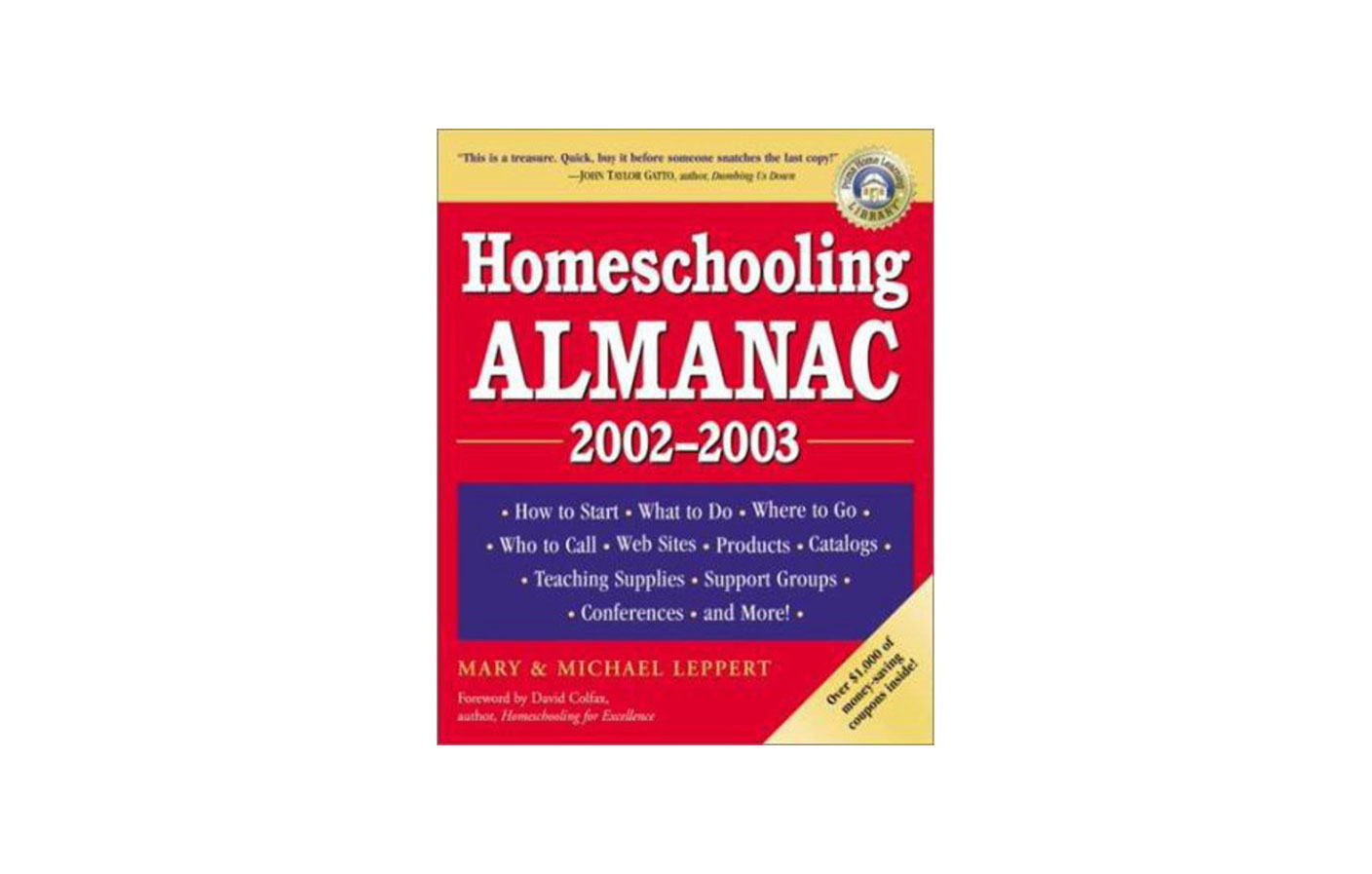
Excerpted from The Homeschooling Almanac, 2000-2001
by Mary Leppert & Michael Leppert
688 pages
Published by Prima Lifestyle, Sept 8, 1999
===================================
Once you have done whatever soul-searching, planning, and arranging you have to do to decide to homeschool, you are ready to contemplate a new future and tackle the basic elements involved in the process.
Say “Adios” to the “Hi/Good-bye” Life
If your family has been living the rat-race routine of school and work with its “hi/good-bye” level of communication, take some time off and relax! I strongly urge any parent who has just taken a child out of school to spend at least a week or two getting to know each other again before jumping into the academic routine. Throw out schedules and routines as much as possible for a while. (If you can’t live “open-ended,” expand your former schedule to make room for your new freedom!) Re-think your life and time values; find out your child’s values. You have a clean slate and a piece of chalk, so to speak; if you make a “mistake,” erase and write over it! Avoid starting the first week with “schooling.” You might instead go to a good museum at 11:00 a.m. Monday, when it is quiet and virtually empty. Have lunch together out in a world that may be novel to your child. Show him what fun can be had in this newfound, free world of maturity. Let him see that important matters go on “out here.” Go to the library or a large bookstore and let him browse as long as he wants. These experiences may rekindle curiosity in a subject not taught in school, and he may feel the spark of desire for learning! He may find a number of topics to explore that would never be possible in school.
In the ensuing days, take hikes or have picnics; do the things you could not do when you were working and he was in school. Get to know each other well. Enjoy being his parent and help him enjoy being your child. He will soon respond favorably to being treated in a more mature fashion than he was in the school world. If you talk to him with your faith and belief in him showing through, he will rise to your expectations. Give it time, lots of time—maybe even a year. Your day is now determined more by the rising and setting of the sun than by clocks and schedules. You aren’t in the hamster-wheel anymore, so let it sink in . . . and enjoy it!
When Michael quit his day job to work full-time at home, it took us over a year to completely adjust to the fact that he was indeed free from someone else’s time clock—not just between jobs or on a long vacation! His “commute” was from one end of the house to the other. His work uniform was no longer a suit and tie. Although we had always enjoyed each other’s company, we had never been together seven days a week except briefly between jobs. We had to make new room for one another and restructure our time and space boundaries. It took some quarreling and discomfort, but now we love nearly every minute. You and your child will have to do the same sort of re-adjusting and re-thinking your former values and schedules. Your child will have the freedom and responsibility of living with his teacher(s); you will have the duty of knowing when to teach and when to be just Mom or Dad.
Define Your Homeschooling Philosophy
Let us assume that to homeschool in your state, you must simply notify the superintendent of your child’s school that she is leaving and you will be homeschooling. Now, what do you do? You first need to determine what homeschooling philosophy you believe in at this time. Unlike what you may be used to from school experience, you need not make hard-and-fast decisions when you teach your own child. No career-track nail-biting, no college-prep or “general education” track decisions will shape the next few years. Nothing is written in stone. You can decide today to be a strict curriculum devotee, following an absolute schoolwork schedule from 8:00 a.m. to noon Monday through Friday, only to find next month that you and your child hate this “school-brought-home” routine and want a freer approach. Then you may explore the techniques and theories written about and utilized by such educators and teachers as Charlotte Mason, Dr. Raymond and Dorothy Moore, and John Holt. As you discover more about your child and yourself, you may interject more of your personalities into your homeschooling efforts. After all, this family you have built and maintained is your “world,” and its road(s) to academic excellence are as uniquely individual as is your daily diet, wardrobe, and vacations. Above all, be yourselves!
Read This Book
To choose a philosophy that fits your family’s personality and needs, you’ll find it helpful to read the methods chapters in this book (chapters 5, 6, and 7). Let each one—parenting, unschooling, eclectic (and other approaches)—sink in, and try to gauge which one(s) might suit your family’s personality. Then look in Part 2, Products for Homeschoolers and Part 3, Resources, particularly for companies that offer catalogs you can pore over to learn about available resources. Order the complimentary copies of the homeschool publications offered in the Coupon section, and read them to discover which philosophy each favors. Each publication has a different slant, and each is enlightening in its own way. Even if you strongly disagree with a philosophy, that is part of your self-discovery.
Homeschooling is like a smorgasbord where you can pick and choose whatever sounds interesting—a math book, an English word game, a history workbook, a map puzzle, whatever strikes your fancy. You will find a huge amount of learning/teaching material, all of which is useful to some homeschooling family—maybe yours! Go to an educational bookstore or large all-purpose bookstore and browse for as long as you can. Ask a salesclerk for information about the educational books and materials. Most also have catalogs available containing many, many titles. Even 20 minutes spent looking here and there will prove invaluable.
Visit Your Public Library
Go to your local library and, once again, just browse through the general information sections, such as American history, world history, math, English, spelling, poetry, and art instruction. Check into whether the library has the Internet. I’ll wager you will be surprised at what you have been overlooking at the library! I found an incredible little history book succinctly detailing all the signers of the Declaration of Independence with a color painting of each—a perfect way to learn about them, especially the less famous ones! Most libraries are excellent (and practically free!) resources for educational and supplemental materials that can help you determine your overall homeschooling philosophy.
Choosing a Philosophy If Your Child Has Never Attended School
Even though you may have a leg up on your schooling counterparts, it is still very wise to really examine what is “out there” for homeschooling. Up until your child reached 5 or 6, you may have had a fuzzy picture of what you wanted for him or her; perhaps a little counting, some word play, reading aloud was enough. Now that he or she is progressing to the “big” world, you may be putting his learning into clearer focus. Avail yourself of the excellent resources at your fingertips; they’re invaluable in determining how to handle homeschooling.
Rethink Your Concept of Schooling
Homeschooling the child who has been in school may seem like an extended summer vacation; in some ways, it is. Much school time is spent on nonacademic activities, such as taking attendance and quieting disruptions. Now your child will be able to devote 100 percent of his study time on point. This means that in only two to three hours per day, he can cover far more than he would during an entire day in the classroom. Some families estimate that more learning takes place in a week of working at home two to three hours per day than can be accomplished in a month of school. Of course, this varies with each school, the family, and the specific experience. Our son will read for hours on end but may fight tooth and claw over five minutes of math presented in a “boring” fashion, such as memorizing times tables or repeating something he has done many times.
If we take a more relaxed, creative approach, giving him the same math facts in a slightly different setting—real measurements, sports statistics, or calculating the number of miles in a light-year—he enjoys the “work” and remembers what he learned! Keep in mind that you can’t always make the work fun, but you can usually give it some real-life connection or purpose; if you cannot, maybe it isn’t worth learning. No one, especially your child, needs his head crammed full of useless information. Be prepared to re-think your opinion of subjects you may have once thought of as acceptable.
Ask Your Child’s Opinion
As you progress in this transition period, ask your child what she wants to know (not just what she wants to learn). What puzzles her? Does she know how your city operates its business day in and day out? Does she know and understand what you and your mate do or did for work? How your bank functions? What credit cards do? Such important real-life topics typically aren’t covered in school. Combine academics and real-life knowledge. One characteristic of schooled children is the lack of initiative when it comes to knowing things. They often say, “We haven’t learned that yet” or “They haven’t taught us that.” This demonstrates that the teacher, not the child, is responsible for knowing. Homeschooling families believe in raising a knowledgeable, self-teaching child who knows how and when to use the dictionary, atlas, phone book, and other reference books on his or her own.
One day, our son asked who owned the Walt Disney Company, so Michael explained about stockholders, publicly owned corporations, boards of directors and presidents, and that anyone, including Lennon, could purchase Disney stock. This widened his eyes for a few seconds and set the wheels turning! We haven’t purchased Disney stock yet but probably will for a good lesson in the stock market.
Lennon also began helping with our bank deposits when he was 9 and is involved in every aspect of our businesses. He knows much more than you would expect of a 13-year-old. Whenever we give him responsibility and authority, he comes through with flying colors. We have been careful, though, to let him grow into these tasks by not giving him jobs we don’t think he can handle. Other homeschooled children we’ve met have similar knowledge and abilities. We contend that your children will respond favorably if given opportunity to grow in this way. Kids are dying to know about and perform “adult” tasks, especially to elicit the praise of their parents and other important elders.
In college, classes you are allowed to choose (as opposed to those required) are called electives. In homeschooling, it helps to remain aware that electives keep the learning process interesting and alive. Children flourish in the autonomy of making such decisions, and you will be delighted how rewarding the learning experience can be.
The “Day After” Day One
Once you have given yourself and your child time to make the transition, you can go to work on the academic portion of home teaching. According to experiences reported through our newspaper, parents feel most comfortable using a prepackaged curriculum for the first year or six months. Thereafter, they often switch to a more customized approach, as discussed below. A prepackaged curriculum (see part 3) comes with virtually everything you need to begin work immediately—textbooks for each subject, workbooks, supplemental books, and any materials referred to in the year’s plan (some even supply pencils and crayons!). Each package includes a detailed teacher’s manual that tells you exactly what to do, and how and when to do it (no guesswork whatsoever!). Prepackaged curriculums are excellent for your introduction into homeschooling, but a word of clarification: The texts included are often written for classes of 30 or more students. As you gain insight into your child as a student and yourself as a teacher, you may lose your taste for such “school mentality.” You will certainly become more skilled at selecting materials, thus producing a customized curriculum that meets your particular needs and goals.
Planning and Organizing
While enjoying your transitional week or two, get a spiral notebook at the drugstore or be fancy-schmancy and buy a Day Runner, Franklin, or other organizer to be utilized exclusively for your homeschooling (some specifically for homeschoolers made by homeschoolers are available, too). On scratch paper, begin roughly arranging your week, Monday through Friday (or whatever days you intend to do schoolwork).
If you use a packaged curriculum, you can still change the order of study the teacher’s manual suggests. For example, you need not start with math on day one just because the manual recommends that. You may do certain subjects daily, based on your student’s “weaknesses.” You may do others, such as an art or craft project, or a “strong” subject, only once or twice a week. Because interests and needs change over time, be prepared to adapt your schedule at a moment’s notice.
The flexibility of homeschooling is a positive feature. After working with you to improve a “weak” subject, your child will probably power ahead in that subject and you can modify his or her schedule to suit changing needs. Home teaching is like a gym for “brain” training, and you are the trainer. As you work a muscle group, it becomes stronger; then you shift your regimen to maintaining that first muscle group’s strength while working another group to make it stronger. With faithful, patient effort, a person can evenly condition his entire body by changing the routine to fit the current situation. Like his muscles, your child’s brain and personality constantly change as he works at the various subjects with you at home.
Water can wear a hole in a stone just by a constant, gentle drip, drip, drip. Be flexible and open to change when you see a “problem” develop with your original schedule. Be self-disciplined instead of obsessive. Raising a knowledgeable, well-adjusted young person involves growing around as well as through obstacles, as trees often do.
Once you have roughed out your ideal schedule, copy it in pencil in your organizer or notebook. The organizer will also help you keep attendance and daily progress records (good for peace of mind and beneficial if your state requires them). If your student is doing high school work, this type of planning and organizing will serve as the basis for your homemade transcripts when the time comes.
A typical homeschooling day is generally based on the schedule you and your child find most comfortable. If your child was in school by 8:30 or 9:00 each morning, you may not have considered what his work personality and habits are. Some students work best first thing in the morning; some need personal time to wake up; some prefer afternoons; others work great in the evening; and still others can work any time, any place, so it doesn’t matter what time they begin and end their daily academic regimen. If your child is the type who must “work” before he plays, or else will accomplish nothing in a day, he should start right after breakfast. The order of the day’s studies will be purely personal, too. Some students have to start with 20 to 30 minutes of their least-favorite subject, when attitudes are fresh. A different sort of personality might like to begin with an English assignment—or writing, reading a history lesson silently or aloud, or doing a geography lesson. The order of studies should depend on personal considerations, which you and your student can work out as you go.
Copyright 1999 by Prima Publishing. Renewed 2026, by Mary Leppert and Michael Leppert. All rights reserved.
The Homeschooling Almanac 2000-2001 is available at Amazon.com.